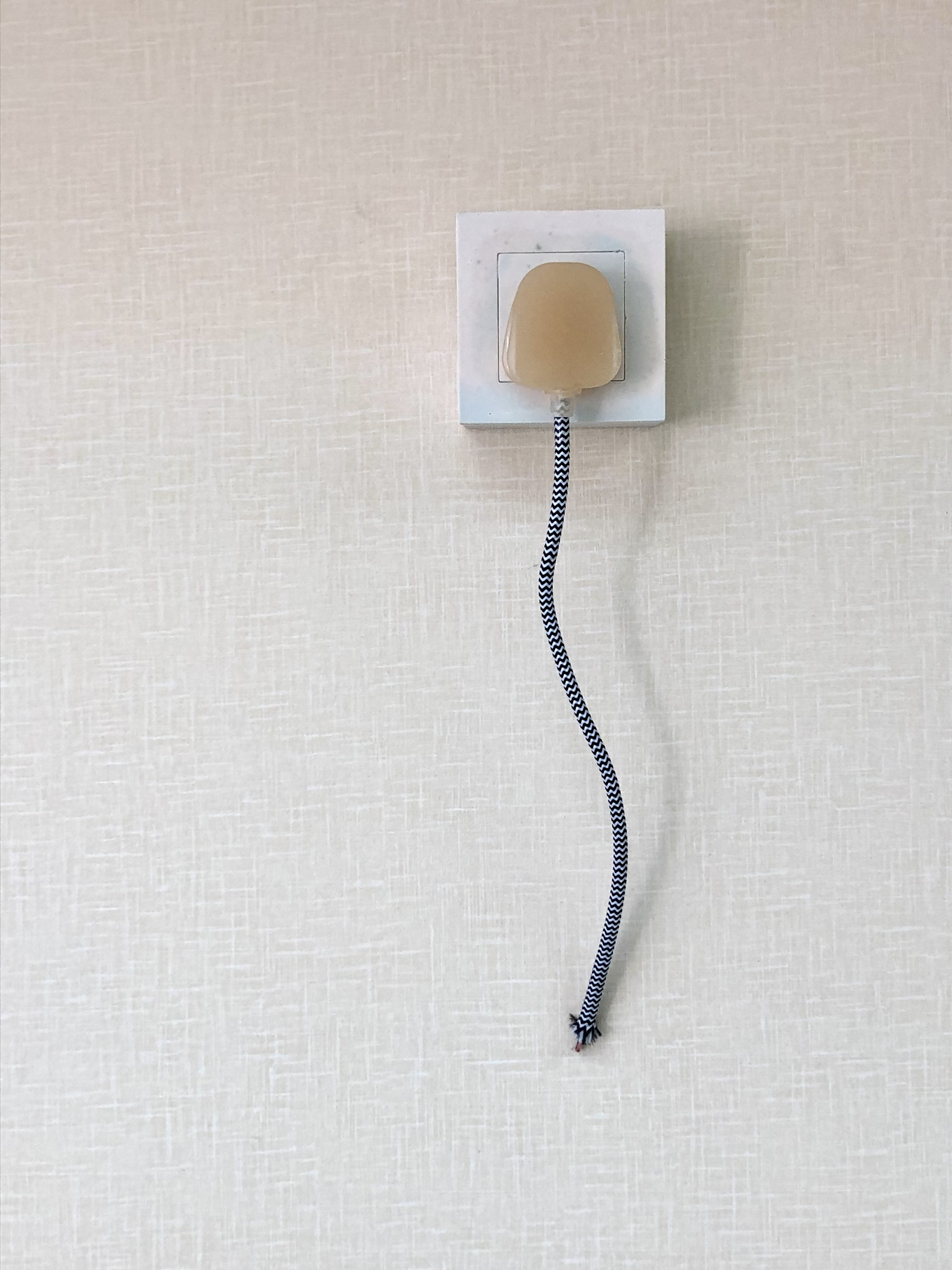
Breaking the Normal Flow of Time / 2021
With its disconnected electrical cords, Breaking the Normal Flow of Time stages an abrupt interruption of electricity, proposing a pause amid the intensified and accelerated technologies that drive contemporary life. Electricity here symbolizes not only energy but also the invisible circuitry that binds mind and body.
Drawing on EMS body massage pads, which use electrical stimulation to provoke involuntary muscular responses, the work investigates this unseen yet commanding force. Resting in a relaxed posture with the pads attached to the artist’s back, the body becomes both receiver and conduit, prompting reflection on the electric signals that enable communication within the brain. From fetal development onward, small electrical voltages animate our neural activity, as neurons fire and interact through chemical messengers known as neurotransmitters.
This fascination with electricity also resonates with the artist’s enduring attachment to the 1990s television series Twin Peaks, directed by David Lynch and Mark Frost, where the staccato motif of “E-LEC-TRICI-TY” recurs as a charged thread linking realities, unstable dimensions, fantasies, and shifting states of consciousness. In this context, the work channels electricity as a hinge between bodies and worlds, between the nervous system and the technological infrastructures that both accelerate and destabilise everyday experience.
Drawing on EMS body massage pads, which use electrical stimulation to provoke involuntary muscular responses, the work investigates this unseen yet commanding force. Resting in a relaxed posture with the pads attached to the artist’s back, the body becomes both receiver and conduit, prompting reflection on the electric signals that enable communication within the brain. From fetal development onward, small electrical voltages animate our neural activity, as neurons fire and interact through chemical messengers known as neurotransmitters.
This fascination with electricity also resonates with the artist’s enduring attachment to the 1990s television series Twin Peaks, directed by David Lynch and Mark Frost, where the staccato motif of “E-LEC-TRICI-TY” recurs as a charged thread linking realities, unstable dimensions, fantasies, and shifting states of consciousness. In this context, the work channels electricity as a hinge between bodies and worlds, between the nervous system and the technological infrastructures that both accelerate and destabilise everyday experience.
* * *